![]() |
![]() |
|
|
||||||||||||||
Warm-ups and Vocal LongevityBy Jeannie DevaNovember 2007 Hello! I hope you�ve been having a good time singing and making this world a better place through music. In the Vocal Aging article, I began answering the following question: �Jeannie, I have been wondering for a long time how age (and other factors like weight), affect vocal range, tone, etc. . . . I wonder how age affects the voice and singing. For example: Elton John sings much lower now. Is it because of age, vocal burnout, both? Steve Perry: Listening to albums in the mid 80s his voice, same as others, changed. Was this age, over-use . . .? Thanks!� David B Once again, here�s the list of factors that can contribute to vocal deterioration (aging):
In this second part of the vocal tip, we shall explore No or Inadequate Vocal Warm-Up or Vocal Cool-Down. History When I first began performing as a singer, I did what so many do; I would pick a song and sing it over and over in different keys, both higher and lower, thinking that I was giving myself a vocal warm-up. Years later, upon discovering and formulating my method of voice training, I initially thought that using basic vocal technique and practicing my new vocal exercises was all that was needed to prepare for performing. Then in the mid 80�s, I began hearing of vocal problems from some of my experienced clients. These singers were already very well versed in my method and were applying it well, so I was perplexed with the description of how tired their voices felt after singing a show. After some further research I discovered that certain principles of muscle function, which I had previously found applied to voice technique, were also involved in why these trained singers were experiencing vocal fatigue. All dancers and athletes know and use these guiding principles, often intuitively, but singers do not often connect with the fact that their body is what is making the sounds - the body is the instrument. Revelation I suspected that �warming up� vocal muscles before performance was needed in addition to the muscle training of vocal exercises, so developed a series of vocal warm-ups as well as vocal cool-downs, taught them to my clients and all their problems went away! Additionally, as I applied them to myself in conjunction with the rest of my method and exercises, I found I could rehearse a show for up to 8 hours, day after day (singing continually and powerfully) and then sing through an entire dress rehearsal of the concert AND perform the concert on the same day as the dress rehearsal and not be at all vocally tired!!! This was pretty conclusive evidence that vocal warm-ups were necessary even for singers who regularly did vocal exercises to develop their voices. Upon further work with this, I found that cool-downs after performing were also important to maintaining vocal health. I cover this more thoroughly in other online lessons in our Archives which is accessible to members of The Deva Club. How It Works If you never do any exercise to strengthen your muscles and then decided to run to catch a bus that just went past you, would you be able to run that fast without strain or breathlessness? Obviously, the answer would be �no.� To run when your muscles are not toned and strong, you would need to force your body to do something it was not prepared for and would likely strain, experience discomfort or fail utterly. Sound familiar? The same thing happens to singers who try to sing without preparing their vocal muscles. On the other hand, if you had been keeping your body in good shape with regular and proper exercise, you still might not catch the bus, but at least it wouldn�t be a painful attempt at running. Now, if you had been doing regular exercise and also had done a warm-up routine shortly before running for the bus, well, you might just sprint fast enough to at least get the bus driver�s attention and have him stop the bus. Two Distinct Actions What we are looking at here is that developing and using your vocal muscles falls into two related but distinctly different activities.
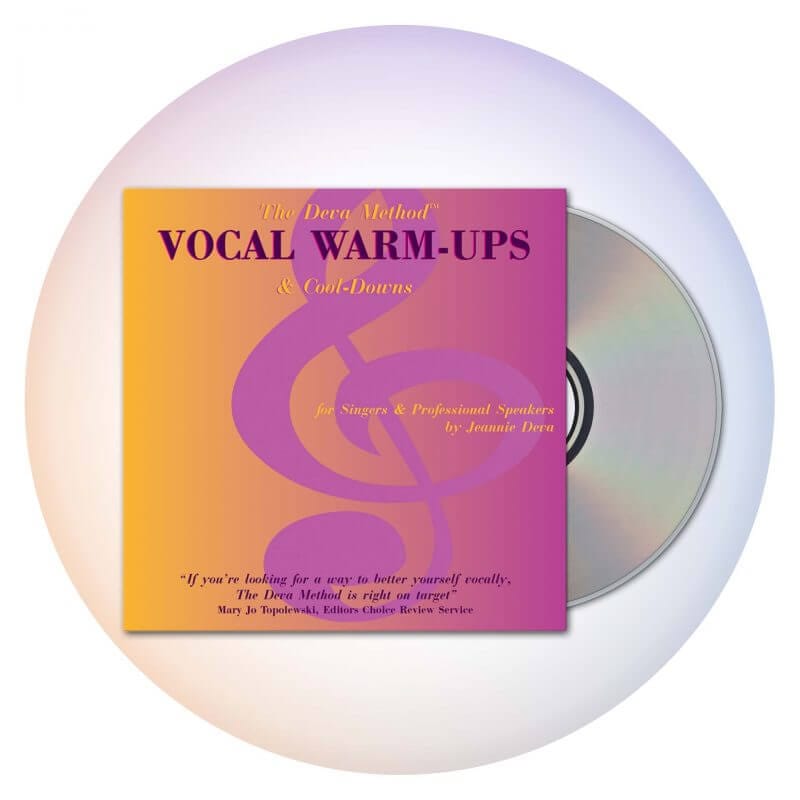
The Solution To ensure that the above problems do not cause your voice to �age,� you need four things technically and in this order: 1) Warm-Up: Specific exercises that limber the inner (and outer) muscles of your vocal instrument and prepare it for the �athletic feat� of singing. (Use my Vocal Warm-Ups and Cool-Downs CD.) 2) Cool-Down: When you finish a rehearsal or performance, your vocal muscles have just done the equivalent of a �long hard run for the bus� and they need cool-downs. This again is the same principle used by athletes, dancers and gymnasts. Muscles get stiff if they are used demandingly and then the activity just ceases abruptly. When used demandingly, muscles pump with blood which brings nutrients, fluids and oxygen into the tissue. Now they can respond to the demand placed upon them; however the increased cellular metabolism also produces byproducts which change the chemistry of the tissue temporarily. If the activity suddenly stops, the byproducts of the heightened cellular metabolism are not flushed out of the muscle tissue so it remains somewhat swollen and may ache. You need to do certain simple cool-downs (not talking or shouting) which will gently flush and thin the muscles out again to return them to a normal chemical balance. Without cool-down, you can find yourself slightly hoarse after a gig or rehearsal. Even for up to three days afterwards, you may find your voice isn�t quite right; it may become husky or fatigued. If you use correct warm-ups and cool-downs along with the next two actions, your voice will remain resilient, allowing you to be the true professional you want to be. 3) Vocal Exercises: These would be exercises that designed to directly and specifically develop stamina, flexibility, range and ease of the use of your voice no matter the volume or style, such as those found in my �Contemporary Vocalist Volume One� book and exercise CDs. 4) Practicing the Songs of Your Set List: An athlete would not just do push-ups or weight training and then expect to be able to execute their gymnastic routine. They practice every detail of their routine to develop both the physical endurance as well as the mental discipline required. You are a vocal athlete so the analogy holds for you too. Singing through the songs as much as you need to add emotion, phrasing, mood and style helps your voice adapt to the increased demand of a performance. Yours in song, Jeannie Deva |
||||||||||||||