Login  |  Cart  |  Search
 
Vocal Warm-Ups
By Jeannie Deva

You may already be familiar with the concept of doing Vocal Warmups prior to rehearsing or performing, but perhaps you haven't been given enough understanding as to why, what to do, and for how long. With this free lesson, you will gain more understanding of the importance and benefit of vocal warm-up(and cool-down) as well as simple and effective exercises.

Thinking of Yourself as an Athlete:

Warm-ups are based upon a principle that is well known to any serious athlete. Prior to putting strenuous demand on muscles, they must be warmed and limbered.Since your instrument is your body, you can consider yourself to be a vocal athlete. From this viewpoint, you can better understand the logic of doing exercises to warm-up the muscles of your instrument, prior to the demands of vocal performance.

The production of your voice is dependent not only on breath, but on the coordinated and small movements of many muscles. External muscles of your rib cage and throat, as well as internal muscles of your larynx, tongue,inner throat, and soft palate, to name but a few, must not only be in good tone, but must be prepared each time, prior to demanding use.

Everyone is different. Your warm-up routines may need to vary on a day to day basis, according to the nature of the performance or rehearsal. The time of day, condition of your body, and the condition of your voice also influence your warm-up. Some singers develop an exact, never varying routine that fits their needs no matter what. However, the more tools you have, the better you will be able to create the right warm-up routine each time.

With a proper vocal warm-up done, you will be able to start your rehearsals or performances in your best shape, rather than risk a blown out voice. The idea is to stretch, tone, and limber your vocal muscles so that they are ready to respond to your needs. This is true whether you are a singer or actor. Treat your voice with respect. Try to stay objective and patient.

Warm-ups help you save, not wreck your voice, assisting performance excellence and career longevity.

Your Breathing:

Your body's breathing mechanism plays a major role in singing.
The following exercise is the first in a series designed to stretch and tone muscles that are vital to this important function. Throughout this exercise keep your mouth open and throat relaxed so that your breathing is unrestricted and occurs naturally in response to the stretch and release of your ribs.

  1. Stand relaxed but erect, with your arms hanging by either side.
  2. Turn your palms forward, facing the wall directly in front of your body.
  3. Open your mouth slightly and keep it open and relaxed throughout the entire exercise.
  4. Stretch your arms up and out to the sides of your body as you slowly raise them. It will be as though you are drawing a large arc with your fingertips around the sides of your body. (As you stretch your arms out and up, air will naturally inhale through your open mouth).
  5. As you continue stretching and raising your arms upwards they will stretch up from your shoulders. Let them angle slightly forward along the sides of your face and bring your palms together as though you were going to dive into a pool. Your out-stretched arms will lift your shoulders and elongate your back muscles. (Your face should be forward not raised. If your stomach is tense, let it relax. Keep your mouth open and relaxed.)
  6. Silently count to 6 while continuing to stretch up.
    (Keep your mouth open and throat relaxed.) Do not breathe in or out.
  7. Now let your arms down faster than you raised them. Bring them down the same way you brought them up. Your breath should naturally exhale through your open mouth as you lower your arms.


Repeat steps 1 through 7 for a total of 20 repetitions.
After doing each 10 repetitions take a few minutes rest.
Done daily, this will take about 15 to 20 minutes.

Face and Neck Massage:

Your sound is made inside your throat by the varied vibration of your vocal folds. Relaxed muscles of the neck permit the inner vocal muscles to move with greater ease.

  1. Reflect on some pleasant thought or memory, or just take on a peaceful state of mind. As you do each step, breathe slowly and deeply.
  2. Begin by massaging the muscles of your face. With the fingers of both hands, start at the top center of your forehead. Using a circular motion, massage down both sides of your forehead to your ears. Massage your jaw in front of your ears, and then your cheeks, under your eyes and chin. Concentrate your massage on these areas until you can feel the muscles soften and relax.
  3. Next massage the muscles of your neck. Use the fingers of both hands. Start just under the back of your head. On either side of your spine, stroke down to your shoulders in one smooth or several short motions. Continue until relaxed.
  4. From the back of your neck, use a few fingers of each hand and begin stroking forward to the sides of your neck. Repeat this motion as many times as necessary, until you feel the muscles relax.
  5. Beginning just behind your jaw on both sides of your neck, stroke downwards to your shoulders. Repeat as many times as you wish. Work slowly and carefully. Continue until any soreness is gone.
  6. With the fingers of both hands, use a short forward stroke on the muscles directly below and under the corners of your jaw. As you feel them relax, work forward to under your chin. Repeat this from the corners of your jaw. Do not push or poke. Maintain a slow, gentle touch and don't forget to breath.


Tongue Relaxer:

Singing and speaking with relaxed muscles at the back of the tongue plays an important part in your voice sounding resonant and free. These next exercises will help to improve the tone and projection of your voice. Open your mouth slightly. Slowly stretch your tongue out and down while letting it remain relaxed. When extended as far forward as possible, slowly stretch it over to one side.
Return it to its stretched and forward position. Slowly stretch it to the other side. Return it to the center stretch. Now slowly retract it into your mouth.

Swallow. Do this sequence only once or twice. It can be repeated later in the day, but don't overdo it. The tongue is a muscle and can be strained.

Lip Trills:

Although this may at first feel silly to do, this exercise provides a wonderful massage for your entire vocal tract (specifically: lips, cheeks, tongue, soft palate, back wall of your throat, and larynx). We will be using vibration to massage your inner instrument. If you have a tendency to tense your throat muscles when singing or speaking, this can help.

  1. Take a breath.
  2. With your lips lightly together, slowly and gently exhale just enough so your lips begin flapping like a "motor boat."
  3. Do this for as long as you can.
  4. Take a breath and repeat. Work on lengthening the amount of time you can do this on one breath. When you have repeated this several times successfully, your lip and cheek muscles should feel energized and relaxed.


Sustained Hums

  1. Take a deep breath, expanding your back open side to side. Maintain that rib elevation with the muscles of the back of your sides while:
  2. You gently hum a pitch in your mid range. Do this for as long as you can.
  3. Time yourself with the second hand of a clock. See how many seconds you can sustain the hum. Repeat several times.

(For more information on ribcage expansion, buy and use "The Contemporary Vocalist Volume 1.")


Resonance Wake-Up:

This warm up does as its name suggests: It wakes up the resonance of your voice. It is also excellent for examining and developing the basic vowel sounds used in singing.
This exercise uses a series of different vowel to consonant combinations. As you do this, use a basic speaking volume only, on a comfortable midrange pitch. The consonant will be an "NG." You shape this consonant with the back of your tongue and soft palate. The back of your tongue raises and lightly meets your soft palate. To find this, say the word "sing" and sustain the "NG" position at the end of the word.


  1. Take a breath. With your mouth kept slightly open and unmoving, rest the tip of your tongue against the back of your bottom teeth.
  2. Put the back of your tongue in the "NG" position and begin sustaining a comfortable midrange pitch.
  3. Feel the vibration shimmer along the roof of your mouth.
  4. Sustaining the same pitch, change to an "AH" vowel (pronounced as in "wand"). The back of your tongue will naturally lower and relax as you sustain the "AH" vowel.
  5. On the same breath, alternate from the "NG" consonant
    with the vowel as many times as you can, NG-AH, NG-AH, NG-AH, etc.
  6. Repeat using the same vowel until you experience muscle relaxation in the back of your mouth and throat. Then go to the next NG-vowel combination.

The sequence goes as follows:

  1. NG-AH (Wand)
  2. NG-EE (Seem)
  3. NG-A (Same)
  4. NG-AA (Apple)
  5. NG-Eh (When)
  6. NG-Uh (Some)
  7. NG-I (Him)


During the next two, be sure you do not shape your lips for the sound. It can be achieved by thinking the vowel sound and letting it naturally resonate against the back
wall of your mouth/throat.

  • NG-Oh (Home)
  • NG-Ooo (Soon)


COOLING DOWN YOUR VOICE:


To use the analogy of the athlete again, demanding use of muscles fills them with blood and waste products. This is true of the muscles of your vocal folds as well.
You can reduce the chance of vocal fatigue and huskiness by using a cool-down to return your vocal folds to their everyday speaking condition.

Cool-down suggestions:

The above exercises: Lip Trills and short Sustained Hums. Also try gently sliding your voice up and down a melodic interval of a 3rd or 5th using the vowels "EE" and "Ah."
Cool-downs must be done at a very low (but not whispering) volume so that your vocal folds are gently vibrating. Cool down until your voice feels and sounds normal.

Vocal warm-up should be done close to the time of performing. Vocal exercising should be done some hours earlier, followed by a vocal rest on the days you are rehearsing or performing. Vocal exercises develop your voice while warm-ups prepare it for performance. A warm-up routine can last anywhere from 10 to 30 minutes. Cool-down is usually 5 to 10 minute. Enjoy!

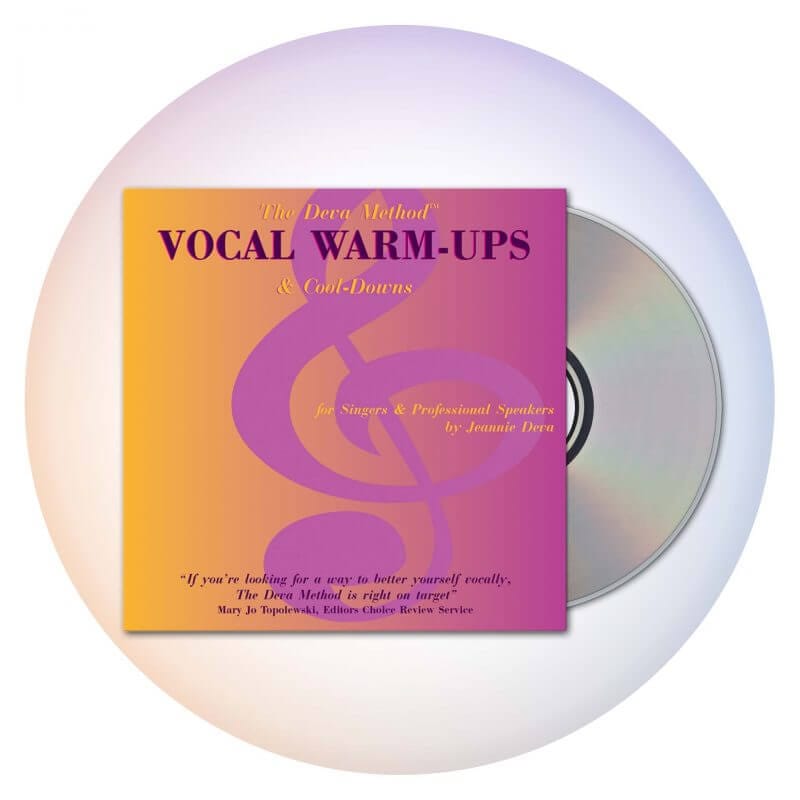
For more vocal warm-ups and cool-downs personally coached by Jeannie Deva, use "The Deva Method VOCAL WARM-UPS & COOL-DOWNS" CD.
Sort By: